Why Practical Training Matters More Than Certifications in Cyber Security
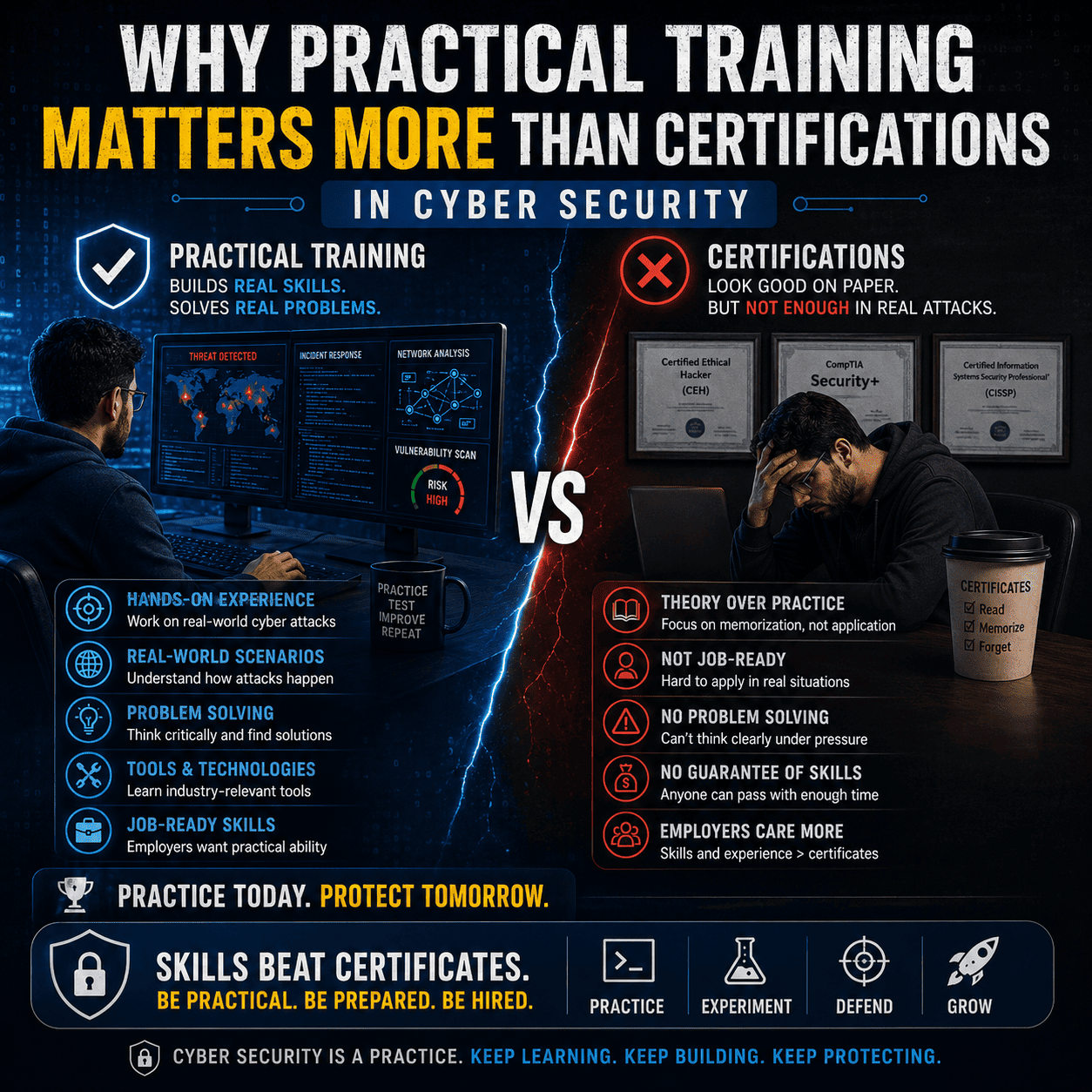
In cyber security, certificates can open doors, but they don’t always prove you can do the job. Employers increasingly prefer candidates who can demonstrate real-world skills, troubleshoot live incidents, and think like an attacker and a defender. That’s where cyber security practical training outpaces classroom theory and standalone cyber security certification. For graduates and working professionals aiming to enter or level up in the field, hands-on experience from a reputable cyber security training institute is the most reliable way to build career-ready competence.
What Recruiters Actually Look For
Recruiters rarely hire based on a certificate alone. When evaluating candidates, they look for evidence that the person can apply knowledge under pressure. Key indicators recruiters prioritize include:
- Demonstrable technical skills, such as malware analysis, log inspection, and network forensics.
- Experience with industry-standard tools and platforms.
- Problem-solving demonstrated through practical scenarios, lab exercises, or incident reports.
- Communication skills for explaining technical findings to non-technical stakeholders.
- A portfolio of projects or contributions to open-source security tools.
A cyber security certification can attest to knowledge, but cyber security practical training shows recruiters you’ve used that knowledge. When you come from a cyber security training institute that emphasizes labs and live exercises, hiring managers see you as lower-risk and more immediately productive.
Importance of Practical Labs
Practical Labs or Hands-on-labs are the backbone of cyber security practical training. Quality cyber security practical training provides sandboxed environments, realistic datasets, and guided labs that map to current industry challenges. Repeated exposure to diverse scenarios helps learners internalize patterns and build speed—both critical during real incidents.
- Recreate attack scenarios: Understand the attacker’s tactics, techniques, and procedures by recreating them in a controlled environment.
- Defense tuning: Configure detection rules, tune alerts to reduce false positives, and learn incident response workflows.
- Tool fluency: Gain comfort with essential tools so they become second nature.
- Failure-driven learning: Make mistakes, analyze what went wrong, and iterate—this cements learning far better than memorizing exam content.
SOC & Ethical Hacking Practice
Two practical pillars of the profession—Security Operations Center (SOC) practice and ethical hacking training— bridge theory and workplace performance.
SOC Practice
- Simulates 24/7 monitoring and alert triage workflows.
- Teaches log correlation, threat hunting, alert prioritization, and escalation.
- Trains analysts to interpret SIEM dashboards, investigate suspicious activity, and produce actionable incident reports.
Ethical Hacking Training
- Trains you to think adversarially, a skill that improves defensive posture.
- Covers reconnaissance, vulnerability assessment, exploitation, and post-exploitation in a legal, ethical framework.
- Builds proficiency in penetration testing methodologies and reporting—critical for red-team and blue-team collaboration.
Together, SOC and ethical hacking training create rounded practitioners who can detect, analyze, and remediate threats. They also prepare candidates for roles ranging from SOC Analyst to Penetration Tester and Security Consultant— roles recruiters actively seek to fill with practically trained talent.
Building a Cyber Security Portfolio
A portfolio is the single best asset to formal credentials. It shows recruiters exactly what you can do. Build a portfolio that includes:
- Lab reports and incident response write-ups from practical exercises.
- Solutions or write-ups demonstrating problem-solving.
- Test summaries (sanitized for confidentiality) highlighting methodology and remediation recommendations.
- Tools or scripts you've developed to automate tasks or analyze data.
- A GitHub or personal site with code samples, examples of log analysis, or sample SOC playbooks.
When you combine cyber security certification with a portfolio created during cyber security practical training, you create a compelling narrative: you know the theory, you've applied it, and you can explain outcomes clearly.
Choosing the Right Training Institute
All cyber security training institute aren't equal. When selecting one, evaluate how well it converts theory into practice:
- Curriculum balance: Ensure the program integrates labs, real-world scenarios, and assessments, not just lectures.
- Lab infrastructure: Look for cloud-based sandboxes, virtual labs, and access to realistic datasets and attack simulations.
- Instructor experience: Prefer instructors with hands-on experience in SOCs, red teams, or incident response.
- Placement support: Good institutes connect students to hiring partners, internships, and live projects.
- Alumni outcomes: Check alumni career paths and employer endorsements to validate the institute's market reputation.
A cyber security training institute that emphasizes practical training will help you build relevant skills and a portfolio aligned with market needs. For example, combining SOC practice with ethical hacking training and regular lab assessments is a strong indicator of a program's practical focus.
FinX Institute (formerly BSE Institute) stands out for its industry-aligned curriculum and emphasis on practical training. Its Post Graduate Diploma in Cyber Security combines practical SOC training, ethical hacking training, and guided project work—designed for graduates and working professionals seeking career-ready skills.
How Practical Training Beats Certification Alone
Certifications measure knowledge but rarely measure competence. Practical training:
- Creates muscle memory for tools and commands.
- Builds judgement under pressure, a critical soft skill during incidents.
- Produces artifacts (reports, scripts, tools) recruiters can evaluate directly.
- Exposes learners to team-based workflows and real-world communication challenges.
- Often results in internships or live projects that demonstrate work experience.
That said, cyber security certification still matters—it provides a baseline and can help with initial screening. The ideal path is certification plus sustained cyber security practical training so you can convert theoretical knowledge into demonstrable skill.
Making Time for Practical Learning as a Working Professional
Balancing upskilling with a full-time job is tricky but achievable:
- Micro-learning: Use short lab sessions (60–90 minutes) focused on a single skill.
- Weekend sprints: Reserve a weekend for focused capture-the-flag events or extended lab work.
- Project-based learning: Build a small, practical project relevant to your current role to make learning immediately applicable.
- Peer study groups: Collaborate with peers for accountability and knowledge-sharing.
A training program with flexible lab access and structured micro-modules supports working professionals better than rigid, lecture-heavy courses.
Measuring Progress: What Success Looks Like
Evaluate practical training through measurable outcomes:
- Time-to-detection and remediation in simulated incidents.
- Number of resolved lab scenarios and their complexity level.
- Number and quality of portfolio artifacts produced.
- Interview performance: ability to explain investigative steps, choice of tools, and remediation decisions.
- Job opportunities, internships, or promotions secured after training.
Recruiters prize candidates who can articulate their hands-on experience clearly during interviews—this is where cyber security practical training shows its value.
FAQs
1. Do I still need cyber security certification if I have practical training?
Ans. Yes. Certifications complement practical training by validating knowledge. Use certification plus practical artifacts to maximize job prospects.
2. How many lab hours are enough?
Ans. Quality matters more than hours, but aim for 100+ guided hands-on hours across several domains (networking, endpoints, web, forensics).
3. How do recruiters verify practical skills?
Through technical interviews, live problem-solving exercises, take-home labs, or review of portfolio projects.
4. How quickly can practical training lead to a job change?
Ans. Depends on prior experience and intensity of training. With focused effort and portfolio-ready artifacts, some professionals move roles within 3–6 months.
5. Should I prioritize a recognized institute or a cheaper bootcamp?
Ans. Prioritize quality and outcomes: well-structured labs, experienced instructors, and placement support typically yield better long-term returns than lower-cost options without practical depth.
Conclusion
In cyber security, the difference between knowing and doing is everything. Cyber security certification provides a valuable baseline, but cyber security practical training is what convinces recruiters you can handle real incidents, tune defenses, and produce measurable outcomes. Hands-on labs, SOC practice, and ethical hacking training build the skills and judgment that hiring managers value most.
If you're serious about stepping into cyber security or advancing your career, choose a cyber security training institute that prioritizes practical, project-based learning and portfolio development. For a balanced, industry-aligned option, consider the Post Graduate Diploma in Cyber Security from FinX Institute (formerly BSE Institute). It blends cyber security practical training, ethical hacking training, and SOC-focused labs to prepare graduates and working professionals for the realities of cyber defense.