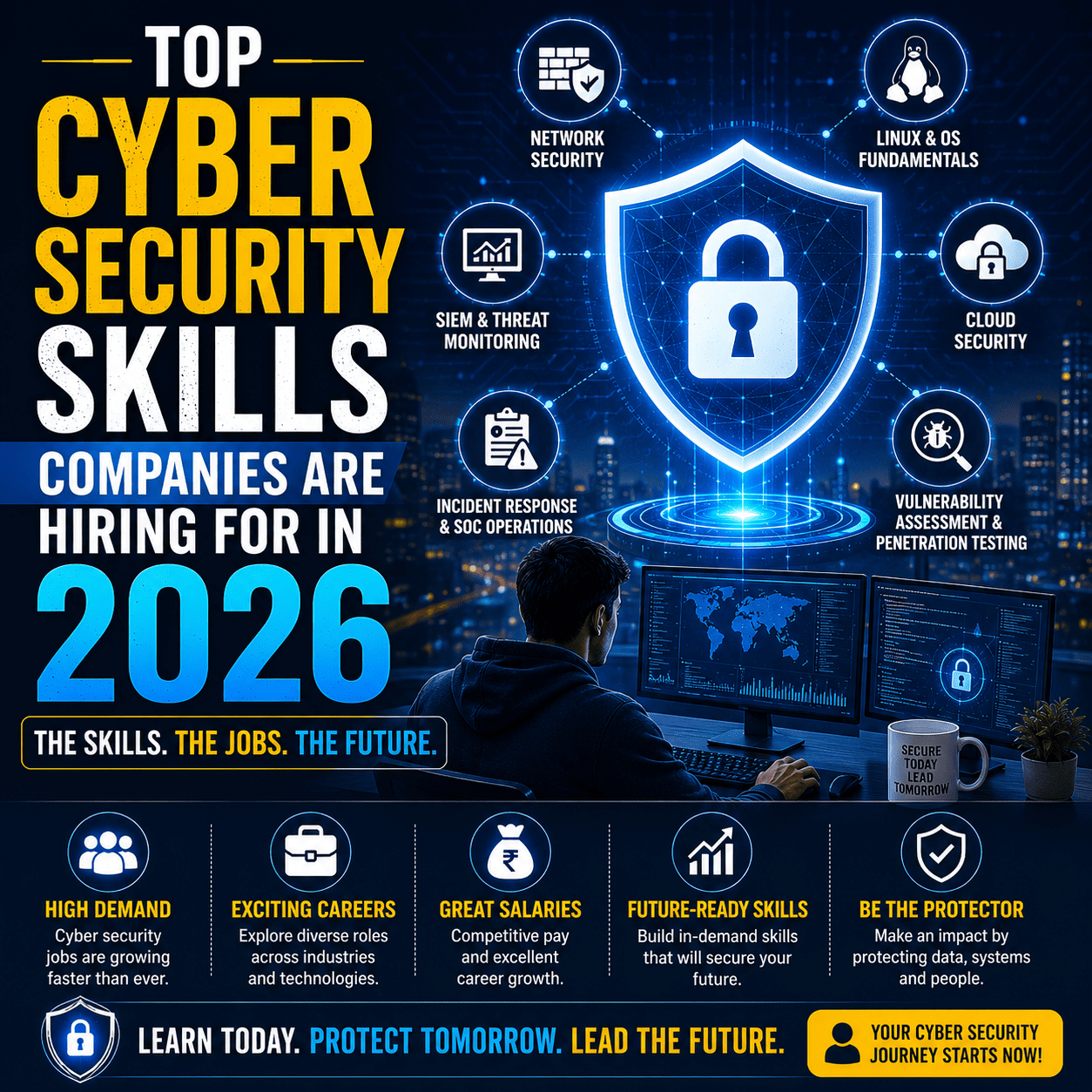
Top Cyber Security Skills Companies Are Hiring for in 2026
Every year, recruiters at banks, IT firms, fintech companies, and government agencies update their job descriptions and every year, the list of must-have cyber security skills grows longer.
This blog gives you the definitive 2026 breakdown of the cyber security skills that top employers in Mumbai are actively hiring for, with the tools, platforms, and cyber security certification programs.
Why Cyber Security Hiring Is Increasing
Cyber security has become a boardroom priority across industries. From banks and fintech companies to healthcare providers and government agencies, organizations are investing heavily in securing digital infrastructure, protecting customer data, and meeting increasingly stringent compliance requirements.
According to IBM's Cost of a Data Breach Report 2024, the average cost of a data breach in India reached ₹19.5 crore per incident, highlighting the growing financial impact of cyber threats on businesses.
Several factors are driving this demand:
- Rapid adoption of cloud technologies
- Increasing ransomware and phishing attacks
- Regulatory requirements from RBI, CERT-In, and global compliance frameworks
- Growth of digital banking and fintech ecosystems
- Expansion of Security Operations Centers (SOCs) across India
For students exploring a cyber security course Mumbai employers recognize, the opportunity has never been stronger. Companies are actively seeking candidates who can demonstrate practical cyber security skills, hands-on experience, and industry-recognized certifications.
Whether you are considering a cyber security diploma, a cyber security certification program, or a comprehensive cyber security course with placement, understanding the most in-demand skills can help you build a successful career in this rapidly growing field.
Network Security Skills
Network security remains the single most foundational area in cyber security. Every other specialisation; cloud security, SOC operations, penetration testing — builds on a solid understanding of how networks communicate and how they can be attacked or defended.
What Employers Expect
- Deep understanding of TCP/IP, OSI model, DNS, DHCP, HTTP/S, and routing protocols
- Hands-on experience configuring and managing firewalls (Cisco ASA, Palo Alto, Fortinet)
- Network segmentation: designing DMZs, VLANs, and zero-trust network architectures
- VPN configuration and remote access security — critical post-pandemic with hybrid workforces
- Intrusion Detection and Prevention Systems (IDS/IPS): Snort, Suricata, Zeek
- Wireless security: WPA3, rogue access point detection, and 802.1X authentication
Tools You Need to Know
Linux & Operating System Fundamentals
If network security is the foundation, Linux proficiency is the toolbox. The vast majority of security tools, server environments, and attack platforms run on Linux. Employers consistently flag Linux comfort as a non-negotiable baseline for any technical cyber security hire.
What Employers Expect
- Command-line fluency: file system navigation, process management, permissions, and user administration.
- Shell scripting (Bash) for automating log analysis, file parsing, and security tasks.
- Understanding of Linux security features: SELinux, AppArmor, auditd, and iptables.
- Windows security: Active Directory, Group Policy, PowerShell scripting, and Event Log analysis.
- Hardening both Linux and Windows systems against common misconfigurations.
- Container awareness: basic Docker security — images, runtime isolation, and secrets management.
The Security-Focused Linux Distribution
SIEM & Threat Monitoring
Security Information and Event Management (SIEM) is the nerve centre of any Security Operations Centre. SIEM platforms aggregate logs from across an organisation's infrastructure — servers, firewalls, endpoints, and applications — and use correlation rules and AI to surface genuine threats from millions of daily events.
What Employers Expect
- Ability to write and tune detection rules and correlation searches
- Log analysis: parsing Windows Event Logs, Linux syslog, firewall logs, and application logs
- Alert triage: distinguishing true positives from false positives efficiently and accurately
- Dashboard creation: building security dashboards for executive and operational stakeholders
- Integration knowledge: how SIEM connects to threat intelligence feeds, ticketing systems, and SOAR platforms
Key Platforms to Learn
Cloud Security Skills
Cloud security has gone from a specialised niche to a mainstream requirement in under three years.
What Employers Expect
- Identity and Access Management (IAM): understanding least-privilege policies, role-based access control, and MFA across cloud platforms.
- Cloud security posture management: identifying and remediating misconfigurations using tools like AWS Security Hub or Microsoft Defender for Cloud.
- Data security: encryption at rest and in transit, key management services (KMS), and secrets management (AWS Secrets Manager, Azure Key Vault).
- Network security in the cloud: VPCs, security groups, NACLs, private endpoints, and WAF configuration.
- Container and Kubernetes security: image scanning, runtime security, and RBAC in containerised environments.
- Compliance-as-code: understanding how cloud environments map to PCI-DSS, ISO 27001, and RBI guidelines.
Platforms & Learning Resources
- AWS Security Training & Certification
- Microsoft AZ-500: Azure Security Engineer Associate
- Google Professional Cloud Security Engineer
- OWASP Cloud Security Project
Incident Response & SOC Operations
No organisation's defences are perfect. When a breach occurs, the Incident Response (IR) team is responsible for detecting, containing, eradicating, and recovering from the attack — while preserving evidence and notifying regulators within mandated timeframes.
What Employers Expect
- Knowledge of the NIST Incident Response lifecycle: Preparation → Detection → Containment → Eradication → Recovery → Lessons Learned.
- Digital forensics basics: disk imaging, memory acquisition, chain of custody, and evidence preservation.
- Malware analysis: static and dynamic analysis of suspicious files using sandboxed environments.
- Playbook development: creating and following structured runbooks for common incident types (ransomware, phishing, data exfiltration).
- Regulatory requirements: understanding the 6-hour CERT-In reporting window and RBI breach notification obligations.
- Hands-on experience with IR platforms: TheHive, IBM Resilient, or ServiceNow Security Operations.
Key References & Learning Resources
Vulnerability Assessment & Penetration Testing
Vulnerability Assessment and Penetration Testing (VAPT) is one of the most exciting and highest-paid technical skills in the cyber security field.
What Employers Expect
- Structured penetration testing methodology: Reconnaissance → Scanning → Exploitation → Post-Exploitation → Reporting.
- Web application testing: exploiting and understanding OWASP Top 10 vulnerabilities — SQL Injection, XSS, IDOR, CSRF, Broken Authentication.
- Network penetration testing: using Metasploit, Nmap, and Netcat for controlled exploitation of network vulnerabilities.
- Mobile application security: Android and iOS app analysis using tools like MobSF and Frida.
- Professional report writing: producing clear, actionable VAPT reports for both technical and executive audiences.
- API security testing: identifying vulnerabilities in REST and GraphQL APIs using Burp Suite and Postman.
Essential Tools
Certifications That Employers Value
Certifications are the currency of the cyber security job market. Here is the 2026 view of which cyber security certification programmes matter most to Indian employers:
-
CompTIA Security+ — Foundation for beginners with a universal baseline.
https://www.comptia.org/certifications/security -
CEH - Certified Ethical Hacker — Intermediate certification for VAPT and ethical hacking roles.
https://www.eccouncil.org/programs/ceh -
CISSP (ISC²) — Advanced certification for senior and managerial security roles.
https://www.isc2.org/certifications/cissp
How Students Can Build These Skills
Knowing which skills employers want is step one. Building them efficiently — without spending years or a fortune — is step two. Here is a structured, practical approach for students starting from any background:
Step 1 — Build the Foundation (Free Resources, 4–8 Weeks)
Begin with the Google Cybersecurity Professional Certificate on Coursera — 8 courses covering networking, Linux, SIEM, Python for security, and more. Financial aid is available for free access.
Supplement with TryHackMe's Pre-Security Learning Path — completely free, browser-based, and beginner-friendly. No software installation required.
Follow Cybrary — a free cyber security education platform with structured career paths for SOC Analyst, Penetration Tester, and Incident Responder.
Step 2 — Enrol in a Structured Cyber Security Course (3–12 Months)
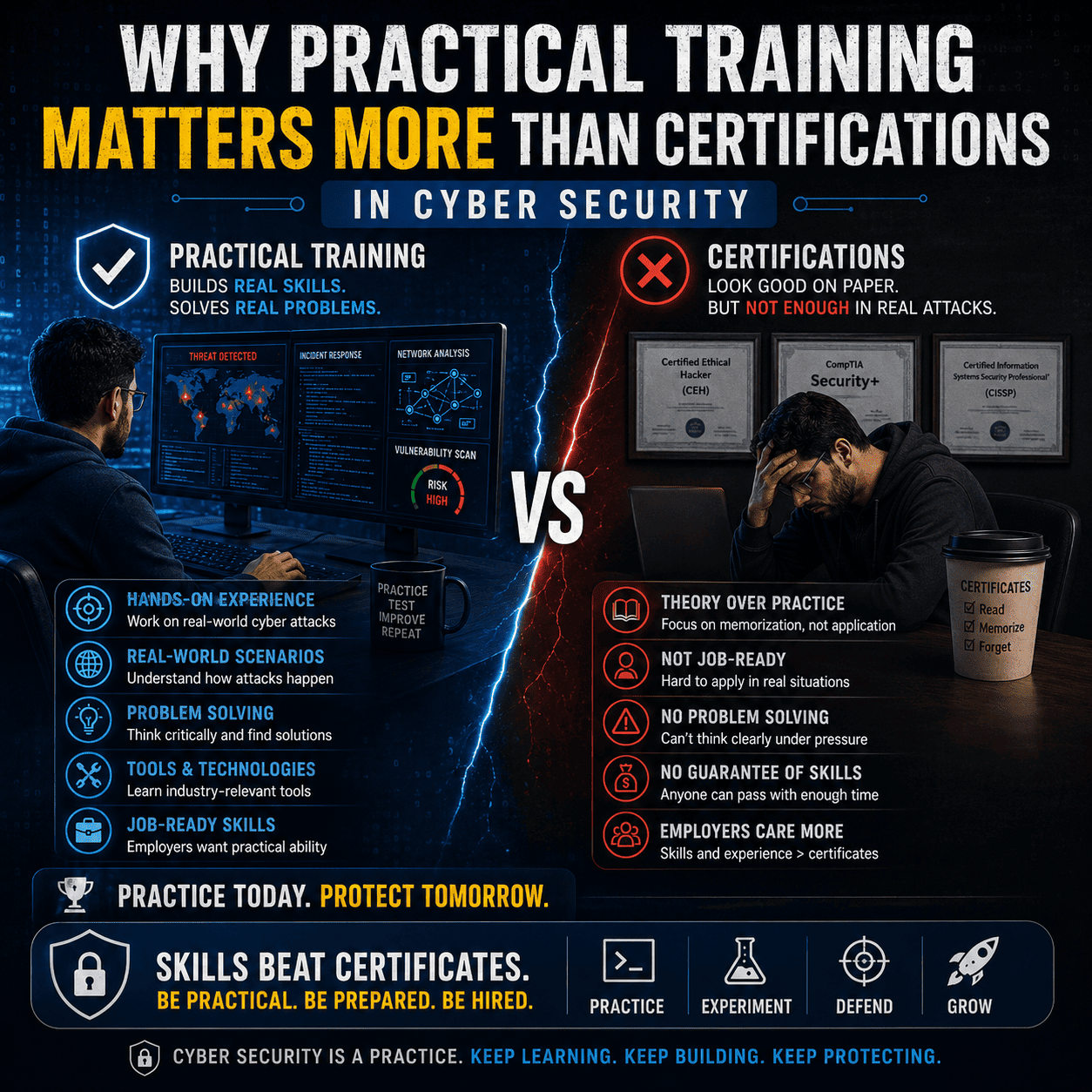
Self-learning platforms provide an excellent foundation, but employers increasingly prefer candidates who can demonstrate practical experience using enterprise-grade security tools and real-world workflows.
Students should look for a cyber security training institute that offers:
- Hands-on security labs
- SOC monitoring exposure
- Industry-led mentorship
- Certification preparation
- Real-world projects
- Placement assistance
Step 3 — Practice in Legal Environments (Ongoing)
Hack The Box | TryHackMe | PicoCTF | VulnHub | CyberDefenders — practice consistently, even 30–45 minutes daily. Progress on these platforms is visible to employers and can be included on your resume.
Step 4 — Get Certified
Start with CompTIA Security+ as your first credential — it is the most widely accepted entry-level cyber security certification program globally and signals to employers that you have a validated baseline of skills. Then layer on a specialisation certification (CEH for VAPT, Splunk for SOC, AWS Security for cloud) based on your chosen track.
Step 5 — Build a Visible Portfolio
- Publish your lab write-ups and notes on a free GitHub repository or personal blog.
- Document your Hack The Box and TryHackMe completions — many employers ask for your profile link.
- Complete a capstone project that solves a real-world problem — a mock VAPT report, a SIEM detection rule set, or a cloud security audit.
- Contribute to open-source security projects to demonstrate initiative beyond coursework.
Step 6 — Apply and Interview
Search actively on Naukri — Cyber Security Jobs in Mumbai, LinkedIn Jobs, and Indeed India — Cyber Security Mumbai.
Conclusion — Start Building Today
The cyber security skills discussed throughout this guide—including network security, Linux administration, SIEM monitoring, cloud security, incident response, and penetration testing—remain among the most sought-after competencies in the industry.
Modern cyber security education extends far beyond traditional classroom learning. Employers increasingly value candidates who can demonstrate hands-on experience, certification-backed knowledge, and practical project work that reflects real-world security challenges.
Whether you choose to begin with free resources, pursue a cyber security certification program, enroll in a cyber security diploma, or join a structured cyber security course with placement, the key is to start building practical skills consistently.
For learners looking for a comprehensive cyber security course Mumbai employers value, a structured learning path that combines technical training, certification preparation, industry projects, and career support can significantly accelerate professional growth.
The demand for skilled professionals continues to rise, and organizations across India are actively recruiting talent capable of protecting critical systems and data.
The best time to begin building your cyber security career is now.