
How to Choose the Right Cyber Security Training Institute in India (2026 Guide)
Cyber security is no longer just an IT function. In 2026, it is one of the most important career paths for students, graduates, and working professionals who want to build future-ready skills. With businesses, banks, fintech companies, government bodies, healthcare organisations, and digital platforms depending heavily on secure technology systems, the demand for trained cyber security professionals continues to grow.
However, choosing the right cyber security training institute can be confusing. Many institutes offer similar-looking courses, certifications, placement promises, and technical modules. But not every cyber security institute provides students with the practical exposure, mentoring, curriculum depth, and career support needed to become job-ready from day one.
This guide will help you understand how to compare institutes, what to check before admission, and why choosing a structured cyber security course with placement support can make a solid difference to your career journey.
Why Choosing the Right Institute Matters
Cyber security is a skill-based field with evolving technical learning. Reading about threats, attacks, firewalls, and ethical hacking is important, but not enough. Employers look for candidates who can understand real-world risks, identify vulnerabilities, use cyber security tools, follow compliance practices, and respond to incidents with confidence.
That is why the institute you choose plays a major role in your learning outcome. The best cyber security training institute is not necessarily the one with the most advertisements. It is the coordination of academic learning, hands-on practice, industry relevance, experienced faculty, mentoring, and placement assistance.
A good institute helps you learn beyond theory and understand how cyber security works in real business environments. It also helps you build a career pathway in areas such as:
- Security analysis
- Ethical hacking
- Network security
- Cloud security
- Penetration testing
- Information security compliance
- Cybercrime investigation
- Application security
- Risk analysis and mitigation
For students who are serious about entering this field, the right cyber security certification or diploma program can strengthen both knowledge and employability.
10 Factors to Compare Before Enrolling
Before selecting a cyber security training institute in India, compare the program carefully on the following factors:
1. Course Structure
Check whether the course follows a clear learning path. A strong program should begin with fundamentals and gradually move into advanced topics such as ethical hacking, penetration testing, cloud security, web application security, compliance, and incident response.
2. Practical Training
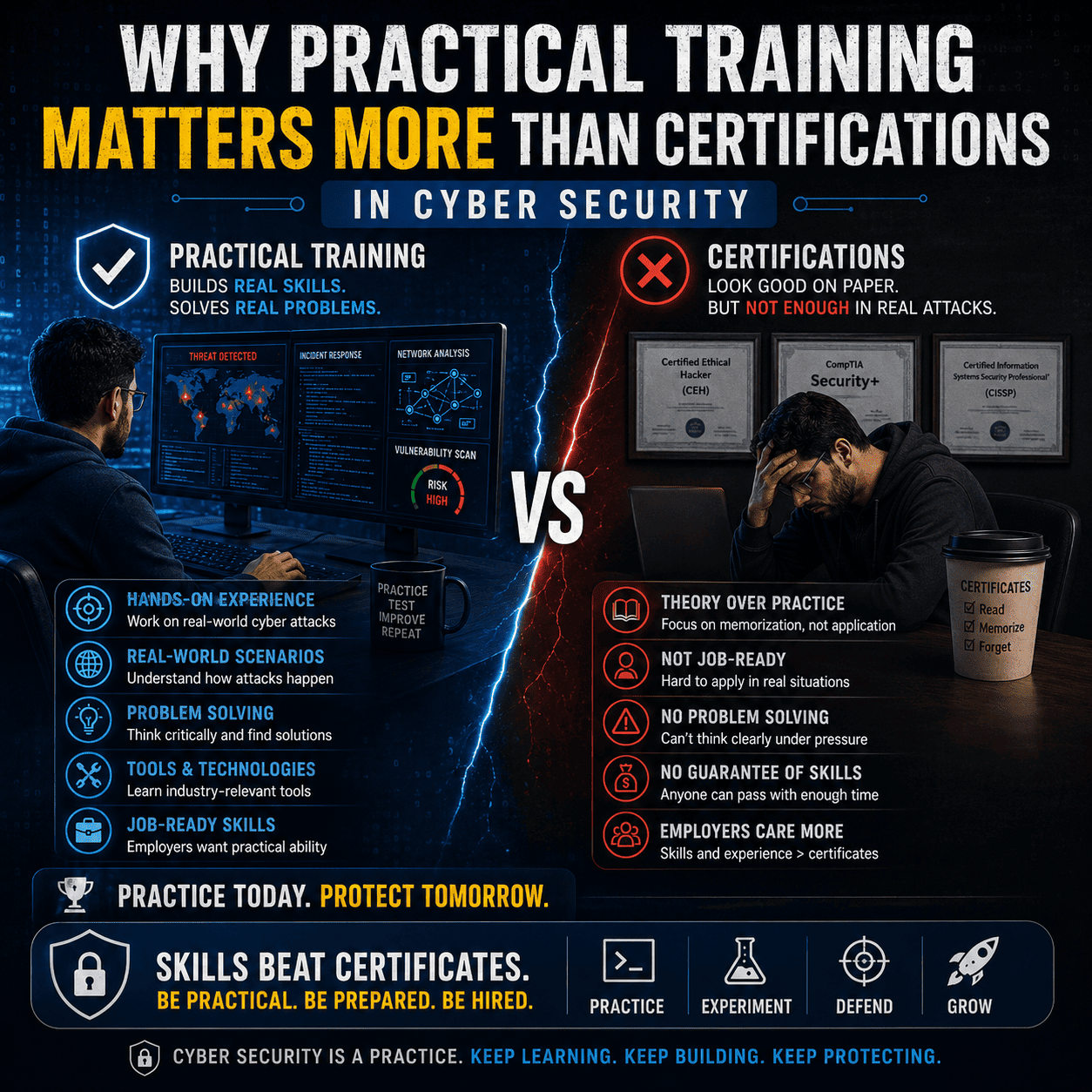
Cyber security cannot be learned only through classroom lectures. Look for practical assignments, case studies, tool-based learning, lab sessions, projects, and simulation-based exposure.
3. Industry-Relevant Curriculum
The curriculum should match current industry expectations. A good cyber security institute should teach topics that are relevant to modern digital businesses, including network attacks, web application security, cloud security, IoT security, risk management, and compliance.
4. Faculty Experience
Faculty members should have academic knowledge as well as practical understanding of the cyber security domain. Industry mentors can help students understand how cyber security is applied in organisations.
5. Placement Support
If your goal is employment, choose a cyber security course with placement assistance. Check whether the institute offers resume guidance, interview preparation, aptitude preparation, placement drives, and industry connections.
6. Affiliation & Academic Credibility
With the curriculum and training quality, students must also check the academic credibility of the program. A cyber security course backed by a recognised academic collaboration can add more value to the learner's profile.
For example, FinX Institute's Post Graduate Diploma in Cyber Security is offered in collaboration with Mumbai University's Garware Institute of Career Education and Development, giving students the advantage of a structured postgraduate diploma pathway along with industry-focused learning.
7. Certification or Diploma Value
A recognised cyber security certification or postgraduate diploma can help improve your profile. Especially with the university-backed structured curriculum, practical training, and academic credibility. Instead of choosing a short-term course only for the certificate, students should evaluate whether the program offers depth, progression, and career relevance.
8. Eligibility and Learning Level
Check whether the program is suitable for your current qualification and career stage. Some programs are beginner-friendly, while others are advanced and designed for graduates or working professionals. FinX Institute's Post Graduate Diploma in Cyber Security, for instance, is designed for graduates, students awaiting final semester results, and working professionals who want to build cyber security skills.
9. Location and Mode of Learning
Decide whether you want classroom, online, hybrid or weekend learning. For students who prefer in-person mentoring and peer interaction, a classroom program can be more effective.
FinX Institute conducts its Post Graduate Diploma in Cyber Security as a classroom program at its Mumbai campus.
10. Career Pathways
A good institute should help students understand possible job roles after completion. Cyber security offers opportunities across IT companies, BFSI, fintech, consulting firms, government agencies, healthcare, and digital businesses.
Hands-on Labs vs Theory-Based Training
One of the most important differences between an average course and a strong cyber security training institute is the level of hands-on learning.
Theory helps students understand concepts such as cyber threats, encryption, firewalls, malware, compliance, and security models. But practical learning helps them apply these concepts.
For example, a theory-based course may explain what a vulnerability is. A hands-on course will help students identify vulnerabilities, understand how attackers exploit them, and learn how to prevent or reduce risk.
Hands-on cyber security learning may include:
- Network security exercises
- Web application security testing
- Ethical hacking demonstrations
- Penetration testing basics
- Risk analysis projects
- Cloud security scenarios
- Cybercrime investigation case studies
- Compliance-based assignments
- Security tool exposure
When comparing institutes, ask whether the course includes practical sessions, projects, labs, or real-world case-based learning. A cyber security certification becomes more valuable when it is backed by applied learning.
FinX Institute's Post Graduate Diploma in Cyber Security focuses on both theoretical and interactive learning techniques, helping learners build a stronger foundation for professional cyber security roles.
Placement Support: What to Look For
Many students search for a cyber security course with placement, but it is important to understand what placement support actually includes.
Placement support does not only mean sharing job openings. A good institute should help students become employable through a complete career-readiness process.
Before admission, ask whether the institute provides:
- Resume-building support
- Mock interviews
- Aptitude test preparation
- Personal interview preparation
- Career counselling
- Industry exposure
- Placement assistance
- Guidance on cyber security job roles
- Support for freshers and working professionals
Also check whether the course helps students prepare for roles in IT security, cyber risk, security operations, compliance, application security, and network security.
A good cyber security institute should not only teach students what cyber security is, but also help them understand where they can build a career after completing the program.
Faculty & Industry Mentors
Faculty quality can strongly affect your learning experience. Cyber security is a constantly evolving field, so students need mentors who understand both fundamentals and current industry practices.
While choosing the best cyber security training institute for your goals, look at the experience of the faculty and mentors. Good mentors can help students understand complex topics in a simpler way and connect classroom concepts with industry examples.
Industry mentors are especially helpful in areas like:
- Ethical hacking
- Penetration testing
- Cloud security
- Cybercrime investigation
- Risk analysis
- Compliance management
- Network security
- Web application security
They can also guide students on how to think like a cyber security professional. This includes problem-solving, investigation, reporting, communication, and decision-making.
At FinX Institute, the learning approach is designed to combine theory, practical exposure, case studies, projects, and expert-led training, helping students build a more complete understanding of cyber security.
Questions to Ask Before Admission
Before finalising any cyber security training institute, ask the right questions. This will help you avoid confusion and choose a program that matches your career goals.
Here are some important questions to ask:
- What is the duration of the cyber security course?
- Is the course suitable for fresh graduates or working professionals?
- Does the curriculum include practical training?
- Are hands-on labs, projects, or case studies included?
- Who are the faculty members and industry mentors?
- Does the institute provide placement assistance?
- What job roles can students apply for after completion?
- Is the course classroom-based, online, or hybrid?
- Does the program include a recognised cyber security certification or diploma?
- What is the admission process?
- Are there eligibility criteria?
- Will students receive interview preparation and career guidance?
Asking these questions will help you compare institutes more clearly and choose the best cyber security training institute based on your needs, not just marketing claims.
Why Consider FinX Institute for Cyber Security Training?
FinX Institute, formerly BSE Institute, offers a Post Graduate Diploma in Cyber Security designed for learners who want to build a career in the cyber security domain. The program is offered in collaboration with Mumbai University's Garware Institute of Career Education and Development and is conducted as a classroom program in Mumbai.
The course covers important areas such as ethical hacking, cryptography, computer networks and security, web application security, cloud security, compliance, penetration testing, cybercrime investigation, and risk mitigation.
Key Highlights
- One-year postgraduate diploma program
- Classroom learning in Mumbai
- Curriculum covering core and advanced cyber security areas
- Joint degree awarded with the legacy of FinX Institute and the credibility of Mumbai University's GICED
- Practical and theoretical learning approach
- Designed for freshers and working professionals
- Focus on employability in IT and cyber security functions
- Industry-aligned learning with mentoring and project-based exposure
For students looking for a structured cyber security course with placement support and practical learning, FinX Institute can be a strong option to explore.
FAQ
1. What is a cyber security training institute?
A cyber security training institute is an educational institution that trains students and professionals in areas such as network security, ethical hacking, data protection, cloud security, cybercrime investigation, compliance, and risk management.
2. How do I choose the best cyber security training institute in India?
To choose the best cyber security training institute, compare the curriculum, faculty, practical training, certification value, placement support, industry exposure, course duration, eligibility, and career outcomes.
3. Is a cyber security course with placement useful?
Yes, a cyber security course with placement support can be useful because it helps students prepare for interviews, improve their resume, understand job roles, and connect with potential career opportunities.
4. What should a good cyber security course include?
A good cyber security course should include computer security fundamentals, cryptography, network security, ethical hacking, web application security, cloud security, vulnerabilities, penetration testing, compliance, and cybercrime investigation.
5. Is cyber security suitable for fresh graduates?
Yes, cyber security can be a good career option for fresh graduates, especially those from technical, science, IT, computer science, engineering, or related backgrounds. Some institutes also design programs for working professionals who want to upskill.
6. What is the value of a cyber security certification?
A cyber security certification or diploma helps validate your knowledge and skills. It can strengthen your profile, especially when combined with practical training, projects, and placement support.
7. Does FinX Institute offer a cyber security course?
Yes, FinX Institute, formerly BSE Institute, offers a Post Graduate Diploma in Cyber Security. It is a one-year classroom program in Mumbai, designed to help students build knowledge in ethical hacking, network security, cloud security, compliance, cybercrime investigation, and other cyber security areas.
8. What career options are available after cyber security training?
After completing cyber security training, learners can explore roles such as Security Analyst, Cyber Security Associate, Ethical Hacking Trainee, Network Security Associate, Compliance Analyst, Risk Analyst, Penetration Testing Trainee, and Information Security Executive.
Conclusion
The right cyber security training institute should offer more than just lectures. It should provide practical learning, strong faculty support, industry-relevant curriculum, recognised cyber security certification, placement assistance, and clear career guidance.
Before enrolling, compare multiple institutes, ask detailed questions, and check whether the program aligns with your career goals. A well-structured cyber security certification or postgraduate degree can help you build the foundation needed to enter one of the most important technology careers of the future.
If you are looking for a classroom-based cyber security course with placement support in Mumbai, FinX Institute's Post Graduate Diploma in Cyber Security is a program worth exploring.