
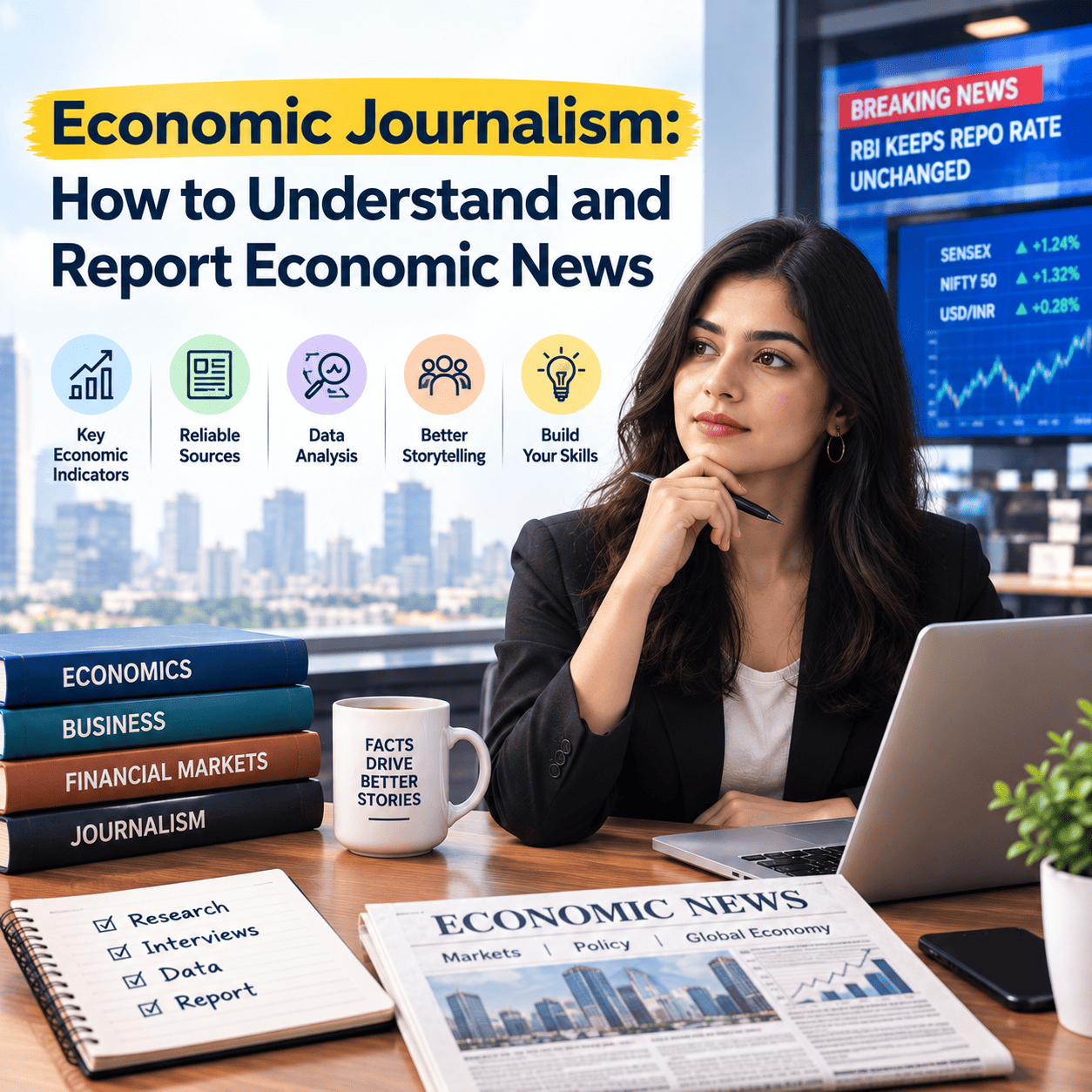
Economic Journalism
How to Understand and Report Economic News
Economic journalism is the specialized branch of reporting that translates complex financial, business, and macroeconomic concepts into clear, accessible information for the general public. It helps readers understand how changes in the economy affect businesses, markets, households, and everyday decisions. It turns subjects such as inflation, GDP, interest rates, employment, government policy, and global trade into clear, accurate, and relevant stories.
For aspiring reporters, learning economic journalism is not simply about following numbers. It is about understanding what those numbers mean, questioning the forces behind them, and explaining their impact to audiences.
What Does Economic Journalism Cover?
Economic reporting usually spans macroeconomics, business, markets, policy, trade, and public finance. A journalist may cover an RBI interest-rate decision one day and explain inflation, employment data, a government budget, or a currency movement the next.
Strong reporting begins with reliable primary sources. In India, journalists can use the Reserve Bank of India for monetary policy and economic data, the Ministry of Statistics and Programme Implementation for official statistics, and company or exchange disclosures for corporate developments.
Key Economic Indicators Journalists Should Understand
GDP
GDP: Gross Domestic Product measures the value of goods and services produced in an economy. Reporters should look beyond the headline figure and compare growth with previous periods and broader trends.
Inflation
Inflation: Consumer price inflation shows how quickly prices are changing. Journalists should explain what rising or falling inflation means for purchasing power, savings, borrowing, and household budgets.
Employment
Employment: Unemployment and labour-force participation data can reveal important changes in jobs, wages, and economic activity.
Interest Rates
Interest Rates: Central-bank decisions influence borrowing costs, investment, consumption, currencies, and financial markets. The Reserve Bank of India publishes monetary policy information and economic research that can provide useful context.
How to Report Economic News Better
Good economic news reporting asks four basic questions: Compared with what? Who benefits? Who bears the cost? What could happen next?
Context is essential. A percentage change means little without a comparison period. Reporters should also watch for base effects, distinguish correlation from causation, and avoid presenting one economic indicator as the complete picture.
Most importantly, connect macroeconomic developments with people. An inflation story becomes easier to understand when readers can see how rising food, housing, transport, or borrowing costs affect households and businesses.
Build Skills for Economic Journalism
Economic journalists need more than writing ability. They benefit from financial literacy, data interpretation, research, interviewing, fact-checking, and an understanding of markets and public policy.
FinX Institute (formerly BSE Institute), offers the Executive Program in Financial Journalism for graduates, journalists, finance professionals, and aspiring business reporters. The five-month online programme covers Fundamentals of Financial Journalism, Business and Economic Reporting, Finance and Financial Markets, Banking and Finance, Global Trade and Finance, Quantitative Methods and Research, Press Laws and Ethics, and Advanced Coding and Data Journalism.
Explore the Executive Program in Financial Journalism at FinX Institute and take the next step toward a specialised career in economic and financial media, grounded in practical industry context.