
Finance + Data Analytics in Graduation:
Why this Combination is the Future?
Finance combined with Data Analytics is a smart choice for graduates. With the demand for tech-savvy finance professionals on the rise, companies seek individuals who can analyse data, predict trends, and make informed business decisions. Choosing this path after 12th can lead to promising career opportunities.
If you are exploring the best course after 12 commerce or researching courses in finance, this combination offers a strong and future-proof career foundation. It prepares you for modern roles where finance meets technology, giving you a measurable advantage in a competitive job market.
Core Subjects You Will Study in Finance + Analytics Courses
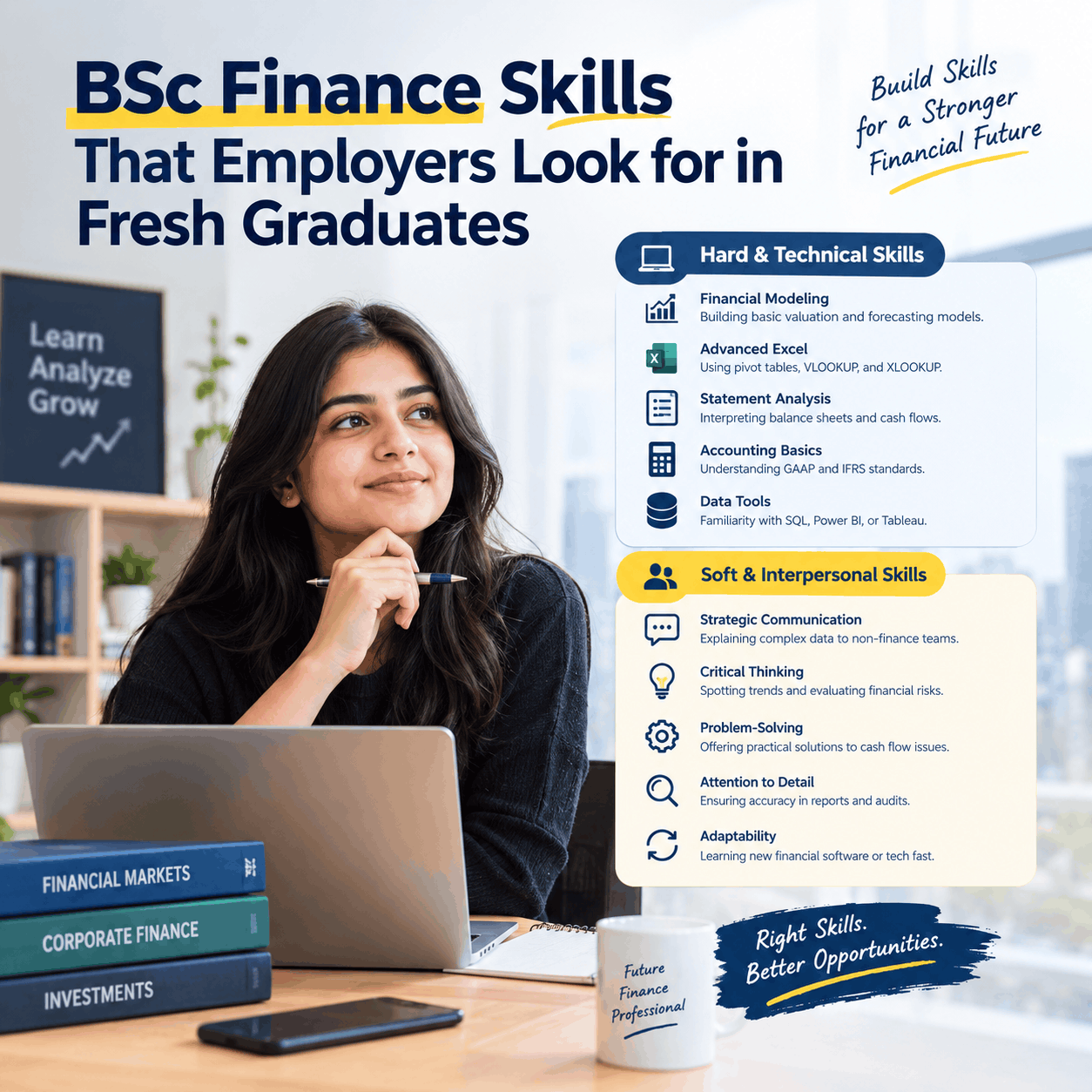
A graduation program that blends finance and data analytics covers both theoretical knowledge and applied skills. Whether you are pursuing a bachelor's degree in finance or a BSc Finance program, the best curricula are designed to build financial understanding alongside data competency so you graduate as both a finance professional and an analyst.
Key subjects typically include:
- Financial Accounting and Corporate Finance
- Financial Markets and Investment Analysis
- Business Statistics and Financial Mathematics
- Data Analytics and Visualization (Python, Tableau, Excel)
- Risk Management and Derivatives
- Capital Markets and Portfolio Management
- Machine Learning for Finance and Predictive Modelling
Entry-Level Roles in Finance and the Stock Market
After graduating in finance and analytics, you'll find various career paths in finance, the stock market, and fintech. Your combination of financial knowledge and data skills leads to both traditional and emerging analytics-driven roles.
| Entry-Level Role | Primary Function | Growth Path |
|---|---|---|
| Financial Analyst | Financial reporting, budgeting, variance analysis | Senior Analyst → Finance Manager → CFO track |
| Equity Research Analyst | Company analysis, investment reports, stock recommendations | Senior Analyst → Fund Manager → Head of Research |
| Risk Analyst | Credit, market, and operational risk assessment | Risk Manager → Head of Risk → CRO |
| Investment Analyst | Portfolio research, asset allocation support | Portfolio Associate → Portfolio Manager |
| Data Analyst (Finance) | Financial data modelling, dashboards, predictive analysis | Senior Analyst → Analytics Lead → Chief Data Officer |
Who Should Choose a BSc Finance Degree After 12th?
A BSc Finance degree is well-suited for students who are interested in financial markets, analytical thinking, and data-driven decision-making. It is not limited to Commerce stream students; anyone with a strong interest in numbers and business can pursue this path.
This course is particularly suitable for:
- Students exploring course after 12 commerce with a finance and markets focus
- Students interested in stock market, trading, and investment careers
- Students who enjoy working with data, statistics, and quantitative problem-solving
- Individuals aiming for careers in banking, capital markets, or fintech
- Students who want a single program that combines financial theory with practical analytics tools
Students from Science and Arts backgrounds are also eligible for most BSc Finance programs, provided they meet the minimum marks requirement, typically 60% aggregate in Class 12.
How to Choose the Best College for BSc Finance
Choosing the right institute is just as important as choosing the right course. Not all programs offer the same level of market exposure, faculty quality, or placement support. When searching for BSc Finance colleges in Mumbai or elsewhere in India, evaluate carefully across these dimensions:
| What to Look For | Why It Matters | Questions to Ask |
|---|---|---|
| Industry-focused curriculum | Ensures subjects align with what employers actually test for in interviews | Does the program include capital markets, derivatives, and financial analytics tools? |
| Internship & placement support | Converts academic learning into real employment | What is the placement record? Which companies recruit from campus? |
| Faculty with real-world experience | Practitioners teach differently from academics — context and live examples matter | Are faculty members currently working in banking, finance, or capital markets? |
| Practical tool training | Employers test Python, Tableau, Excel, and SQL in analytics + finance interviews | Which software tools are covered? Are there lab sessions? |
| Industry certifications included | NISM certifications are mandatory for many BFSI roles; CFA-aligned subjects add value | Is NISM preparation included? Does the curriculum align with CFA Level I? |
| Strong industry connections | Internship pipelines and alumni networks determine job quality, not just job quantity | What is the alumni network? Are there structured industry tie-ups? |
Which Institute Offers a Finance + Data Analytics Degree in India?
When comparing BSc Finance colleges in Mumbai, one institution that stands apart is FinX Institute (Formerly BSE Institute). Unlike general management colleges, FinX Institute was established in 1989 as a direct subsidiary of the Bombay Stock Exchange, making it the world's first capital markets learning space. This institutional origin shapes everything: the curriculum, the faculty, the market exposure, and the placement network.
Before selecting any program, compare the following across institutes:
- BSc Finance course details: which subjects are taught and with what depth
- Industry exposure: live market training, trading simulations, or BSE ecosystem access
- Certifications included: NISM preparation, CFA-aligned content, or regulatory framework training
- Placement record: which companies recruit, average packages, and OJT quality
- Location: proximity to Mumbai's BFSI employers is a measurable career advantage
- Fees and value: cost relative to curriculum depth, placement outcomes, and faculty quality
In today's competitive world, simply holding a degree is not enough. Employers across BFSI, fintech, consulting, and e-commerce are specifically looking for graduates who combine financial knowledge with analytical capability, professionals who can not only read a balance sheet but also build a predictive model, design a dashboard, and recommend a data-backed decision.
A graduation program that integrates finance and data analytics is one of the most future-proof choices available to students after 12th grade. For those exploring BSc Finance colleges in Mumbai or any courses in finance with real industry relevance, the key is to look beyond the degree name and evaluate the depth of the curriculum, faculty quality, and placement track record of the institution you choose.
Explore Finance + Analytics Programs at FinX Institute
BSc Finance | BMS in Capital Markets | PG Diploma in Predictive Analytics
Visit: finxinstitute.com/undergraduate-courses
Call: 1800 892 9030
Email: Finxinstitute Training